I thought I would start with this photo. I find it absolutely captivating. Both the young girl and the monkey seem to be looking deep, deep into my soul – no judgment, simply innocent questioning, curiosity, wary trust and asking me – “have you done all you can Urmas”? And I can only reply, “I have tried but not hard enough. I will leave you with a difficult world, one you do not deserve. May The Great and Sacred Mystery be kind to you, I wish I could have done more.”
It has been a privilege and an honor to have worked these past 14 years with “The Whale People”.

And the preceding 35 years as a teacher. I thank The Gods that I was able to find these avenues of expression within which to devote my life. I was fortunate to have experiences and the time for contemplation during those years so that I did not waste the time of my students.

In the great Kiva Rinconada in Chaco Canyon – contemplating and strengthening years ago before my journey with “The Whale People”.

Another of the “critters” that I have found so intriguing over the years. It is nice to see that their intelligence is now accepted by most everyone. Not a moment too soon!
Anup
Shah has photographed many intelligent, charismatic animals, but he says great
apes are unique—even a bit eerie. “You’ll find that they’re studying you.”
Language may have originated as early as 100,000 BC! A study
of macaque monkeys supports the idea that languages may have evolved to replace
grooming as a better way of forging interpersonal bonds. Another theory is that
our ancestors began to develop language by imitating natural sounds, like bird
calls and animal noises. And another theory is that human communication may
have started with the emanation of involuntary sounds: distress sounds from
pain or surprise, or wails of sadness, or cheers of joy or triumph.
Perhaps not so
intelligent but oh so beautiful. I wish I could give more information on this
particular dragon fly but alas I cannot.

And how about this “critter”? So much beauty in nature – takes my breath away.

This
first-ever photo of a live larval cusk-eel features a frilly, external stomach,
which likely helps the fish absorb nutrients from the surrounding water. The
dangling protrusions may also deter would-be predators, given their resemblance
to the stinging cells of other, more dangerous sea-dwellers. Off the coast of
Kona with photographer Jeff Milisen.
https://www.facebook.com/biographic.magazine/photos/a.1168248919861716.1073741828.1124522697567672/1780642241955711/?type=3&theater
A
BIT OF ANTHROPOLOGY/ARCHEOLOGY
The
full extent of the First Nations People in The Americas has been hotly debated
over the years. It was imperative during the European Invasion beginning with
Columbus for their numbers and sophistication to be minimized in order to
lessen the full extent of the attempted genocide of as many as 90 million
people. New archeological techniques are now revealing just how sophisticated
many of them were.
"Maybe, eventually, we would have gotten to this hilltop where this fortress is, but I was within about 150 feet of it in 2010 and didn't see anything," Mr Garrison told Live Science.

While Lidar imagery has saved archaeologists years of on-the-ground searching, the BBC was told that it also presents a problem.
"The tricky thing about Lidar is that it gives us an image of 3,000 years of Mayan civilization in the area, compressed," explained Mr Garrison, who is part of a consortium of archaeologists involved in the recent survey. He believes the scale and population density has been "grossly underestimated and could in fact be three or four times greater than previously thought".


A great deal of their wisdom has still been preserved though most of the treasures of that wisdom are just now being rediscovered.

I added my own very small contribution to a better understanding of this part of US history by investigating the passage of one of the many California tribes, The Huchnom.

It is available through The Mendocino Historical Society Poage Library in Ukiah, CA.
A LITTLE SCIENCE
If space travel is to become a reality, there are some serious new technologies needed. One is how to minimize weight during long duration space flights. Sufficient food is a real concern. Well, just as with water, which has become less of a concern due to discovery of unexpected sources waiting in space, the food issue may be on its way to resolution.
Geoscience researchers at Penn State University are finally figuring out what organic farmers have always known: digestive waste can help produce food. But whereas farmers here on Earth can let microbes in the soil turn waste into fertilizer, which can then be used to grow food crops, the Penn State researchers have to take a different route. They are trying to figure out how to let microbes turn waste directly into food.

There are many difficulties with long-duration space missions, or with lengthy missions to other worlds like Mars. One of the most challenging difficulties is how to take enough food. Food for a crew of astronauts on a 6-month voyage to Mars, and enough for a return trip, weighs a lot. And all that weight has to be lifted into space by expensive rockets.
For those of us who support our human quest to understand more about our vicinity in the galaxy and perhaps the universe, this is another step forward in that quest.
https://www.universetoday.com/138419/microbes-may-help-astronauts-turn-human-waste-food/
And
there’s plenty of “space” out there to explore!
As of February 1st, 2018, 3,728
planets have been confirmed in 2,794 systems, with 622 systems having more than
one planet. But now, thanks to a new study by a
team of astrophysicists from the University of Oklahoma, the first planets
beyond our galaxy have been discovered! Using a technique predicting by
Einstein’s Theory of General Relativity, this team found evidence of planets in a galaxy roughly
3.8 billion light years away. It’s called a “Gravity Lens” and
literally opens up new vistas!

And
here’s something to tickle one’s neurons! Once again from one of our
enlightened “scientists” (Great Mystery bless them all!).

According to biocentrism, a new “theory of everything,” the
material and immaterial worlds are co-relative.
“Say what”?

Life and consciousness represents one side of the equation,
matter and energy the other. They can’t be divorced; split them and the reality
is gone. Although the current scientific paradigm is based on the belief that
the world has an objective observer-independent existence, a long list of
experiments shows the opposite.
OK,
last bit of astronomy
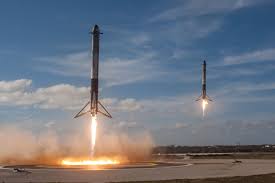
KENNEDY SPACE CENTER, Fla. — From the same pad where NASA
launched rockets that carried astronauts to the moon, a big, new American
rocket arced into space on Tuesday. But this time, NASA was not involved. The
rocket, the Falcon Heavy, was built by SpaceX, the company founded and run by
the billionaire entrepreneur Elon Musk.

This
was really cool because the two external fuel containers landed vertically on
their own retro rockets – a first and very important.
This section not written by me:
Viewed
from above, these Norwegian waters look serene. But the placid surface and lazy
shadows that shift in seeming slow motion belie the controlled chaos
transpiring below. A dense cloud of Atlantic herring (Clupea harengus) spins
like a cyclone, each fish seeking shelter amidst its neighbors as two killer
whales (Orcinus orca) shape and break the undulating mass. The whales drive
holes through the school’s center and slurp up herring they’ve stunned with
swipes of their massive flukes. Humpback whales (Megaptera novaeangliae) patrol
the edge of the cloud, periodically charging through it, mouths agape like
enormous nets of baleen and flesh.

Coast of
Kvaloya, Norway
Such frenzies—some lasting only minutes and others
upwards of an hour—will occur repeatedly for up to five months while the
herring overwinter in shallow fjords. But it hasn’t always been this way.
Before 2010, herring populations in this region spent winters farther out to
sea, where they were pursued by killer whales, but never encountered humpbacks.
Exactly what prompted the herring schools to move closer to shore and spill
into Norway’s fjords isn’t clear, but the relocation put them directly in the
path of migrating humpbacks. Suddenly, all three species were in the same place
at the same time, and the stage was set for some unusual, and previously
undocumented, behaviors.
The relationship between killer whales and humpbacks in most places and scenarios is one of conflict—killer whales preying on young humpbacks, or adult humpbacks banding together to drive off the smaller predators. Here, it seems, the food resource is rich enough that it’s more productive for both whale species to focus their efforts on the herring instead of each other. Indeed, in a study published earlier this year, researchers found that killer whales and humpbacks more often than not work together to herd the fish into tight schools and systematically take their respective mouthfuls. While the killer whales appear to be doing the majority of the herding, with the humpbacks serving as the opportunists, these observations demonstrate just how dynamic our oceans are—and how resilient organisms can be—in the face of changing environmental conditions.
The relationship between killer whales and humpbacks in most places and scenarios is one of conflict—killer whales preying on young humpbacks, or adult humpbacks banding together to drive off the smaller predators. Here, it seems, the food resource is rich enough that it’s more productive for both whale species to focus their efforts on the herring instead of each other. Indeed, in a study published earlier this year, researchers found that killer whales and humpbacks more often than not work together to herd the fish into tight schools and systematically take their respective mouthfuls. While the killer whales appear to be doing the majority of the herding, with the humpbacks serving as the opportunists, these observations demonstrate just how dynamic our oceans are—and how resilient organisms can be—in the face of changing environmental conditions.

But the green algae is not limited to the egg cases—it’s also located inside cells of a mature salamander’s body. As previous research has shown, the algae enter the eggs, proliferate, and then later invades the tissues and cells of the developing embryos. Aside from the initial egg and algae symbiotic relationship, it wasn’t known if this subsequent arrangement incurred any kind of benefit, or if it was simply a residual or parasitic infection.
https://gizmodo.com/scientists-just-found-a-completely-new-kind-of-symbioti-1794811939
And this:
Mexican
night snakes are one of 20 species known to dangle from cave ceilings, waiting
to snatch a passing bat out of the air. But success is by no means
certain—scientists have seen it take up to 200 strikes for a snake to land its
prey with this strategy.

SOME GEOGRAPHY
Interesting theory on glaciation and note the proposed time frame – humans were here.
According to modern theories of geological evolution, the last major ice age (known as the Pliocene-Quaternary glaciation) began about 2.58 million years ago during the late Pliocene Epoch. Since then, the world has experienced several glacial and interglacial periods, and has been in an inter-glacial period (where the ice sheets have been retreating) ever since the last glacial period ended about 10,000 years ago.
According to new research, this trend experienced a bit of a hiccup during the late Paleolithic era. It was at this time – roughly 12,800 years ago, according to a new study from the University of Kansas – that a comet struck our planet and triggered massive wildfires.


Of
greater concern is this bit of news from the UN study group on Climate Change.

A glacier calves icebergs into a fjord off an ice sheet in
southeastern Greenland on Aug. 3. (David Goldman/AP)
The document finds that the world has only 12 to 16 years
worth of greenhouse gas emissions left, from the start of 2016, if it wants a
better-than-even chance of holding warming below 1.5 degrees.
https://www.washingtonpost.com/news/energy-environment/wp/2018/02/14/leaked-u-n-climate-report-sees-very-high-risk-the-planet-will-warm-beyond-key-limit/?utm_term=.5ee9e654542eAND FINALLY SOME HISTORY
Just a last historical note. Again not written by me but an interesting read for those curious about the last of The Napoleon dynasty. That being Napoleon III, emperor 1852-70

It was a turbulent time in Europe. The year was 1870, and the Kingdom of Prussia held the reins of power. Prussia’s king, Wilhelm, was a hardened military veteran, and his chancellor, Otto von Bismarck, was a shrewd and ruthless politician. Their goal had for years been the unification of Germany under the flag of Prussia, and this goal was near to fulfillment.
In France, the head of state was the emperor Napoleon the Third, nephew to Napoleon Bonaparte. Bonaparte had been defeated in 1815 at the famous battle of Waterloo, but not many years had passed before Napoleon III, Louis-Napoleon, had returned to France and taken the title of Emperor for himself. He had gained the support of the French National Assembly, and of the French people, and had ruled the country for nearly twenty years before the outbreak of the war with Prussia.
He was a man who, as ruler, embraced the modernization for France. Railways were built, and huge construction projects were undertaken in Paris. He was responsible for the planting of the Landes forest in the Gironde area of France while in Paris many old gardens were replanted and refurbished, and new parks and gardens were created. He was also a political reformer, and under his rule he established the right of workers to take strike action against their employers. At the same time, he worked to improve women’s access to education and formed a number of new universities.
He was a man who, as ruler, embraced the modernization for France. Railways were built, and huge construction projects were undertaken in Paris. He was responsible for the planting of the Landes forest in the Gironde area of France while in Paris many old gardens were replanted and refurbished, and new parks and gardens were created. He was also a political reformer, and under his rule he established the right of workers to take strike action against their employers. At the same time, he worked to improve women’s access to education and formed a number of new universities.
When a Prussian prince seemed set to inherit the throne of
Spain, the French feared that they would find themselves encircled in an
alliance of Prussian states. At once, they sent an envoy to Bismarck to demand
that the candidacy be withdrawn. A telegram reached Paris, which implied that
the French ambassador had been insulted by Bismarck. The flames of public
opinion in Paris, fanned by the French newspapers, swiftly got out of hand.
20,000 people marched on the National Assembly, demanding war. The outcome was
inevitable, and the fate of Louis-Napoleon’s empire was sealed.

Napoleon and Bismarck discuss terms after The French defeat
at Sedon.
“Some people believe that, by burying ourselves under the ruins of Sedan, we would have better served my name and my dynasty. Nay, to hold in my hands the lives of thousands of men and not to make a sign to save them was something that was beyond my capacity… my heart refused such sinister grandeurs.”
https://www.warhistoryonline.com/instant-articles/heart-refused-sinister-grandeurs.html
And me – well, I continue to thank The Great and Sacred Mystery for guiding my journey here to Mexico and the embrace of Grandmother Ocean.


Que Les Vaya Bien, amigos