Friday, August 31, 2018

 I am terribly sorry but for some reason my computer refuses to enlarge the script and make it uniform. I did everything as usual and gone back a dozen times to edit it so it is uniform. I will work it out next time.

Just wanted to start this months blog with one of my really happy pictures. Yes, that's me worshipping  the beauty of nature at Calf Creek Canyon back in 1995. One of the most beautiful spots I've ever been.

Staying on the theme of beauty for a bit isn't this a stunning picture.


And not to be out 
done, how about this Attalus atlas moth?

Or this Boxer crab?

With a massive clutch of bright orange eggs spilling out from under its shell, this boxer crab (Lybia tessellata) looks like an easy—and calorie-rich—target, but don’t be fooled. She’s got two not-so-secret weapons. In the grasp of each of the crab’s two main claws is a tiny live anemone, equipped with stinging tentacles. And true to the crustacean’s other common name—the pom-pom crab—she’s not shy about displaying them.


So much beauty on this planet and we haven't even discovered (in the biological sense) a tenth of it.

More people may have appreciated all this long before us. Here's some new research which is interesting to speculate on if nothing else.

We’re used to imagining extinct civilizations in terms of sunken statues and subterranean ruins. These kinds of artifacts of previous societies are fine if you’re only interested in timescales of a few thousands of years. But once you roll the clock back to tens of millions or hundreds of millions of years, things get more complicated.


A civilization which is familiar to us but constantly provides new sites and also underscores the sophistication of these cultures is The Maya of The Yucatan of Mexico.


CerĂ©n was discovered entirely by accident. As grain-storage silos were constructed in 1976, one of the clay houses buried underground was unearthed by a bulldozer. Two years later, anthropologist Payton Sheets was on an archaeological survey in the country when a local man mentioned the uncovered buildings. After visiting the site and discovering a thatch roof still intact, Sheets, a professor at the University of Colorado, figured the house couldn’t be more than a century old since thatch is usually replaced every 20 years or so due to the hot, humid weather in the region. However, radiocarbon dating showed that it was 1,400 years old. This was an incredible find because it “really shows the richness and sophistication of the lives of Maya commoners” he says, whereas before this discovery, information was mainly about the Maya elite.



If you have  been following this blog you probably are aware that right now is not the time of The Whale People here in the south but I thought I would bring them on board anyway just because I love them and I know you do too.


Just a few years ago the first (only ?) white whale was sighted in Australian waters. Now it appears some reproductive activity has been going on because it appears that there may be as many as three...or have we been missing them?

And another whale rescue....HOOHAH!!

A humpback whale entangled in rope and chain in Tonga's Ha'apai Islands was successfully freed on Friday, July 27. Passengers and crew from NAI'A had to scuba dive to cut away the weighted lines that were so dangerously wound around the whale's body that it could barely stay at the surface to breathe. 


"Good on ya", Whale People! And the brave human souls that are rescuing them. 

We may now be a modern and scientific people, but standing beneath a whale skeleton in a city museum, who isn’t still drawn into a reverie of wonder and speculation? How whopping were those tail flukes, long since decomposed? How might it feel to be alive on that scale—to experience the world in such stupendous dimensions of sensation and action? What dark, red secrets lie in the cubicles of a whale’s heart? Nick Pyenson, a paleobiologist and the curator of fossil marine mammals at the Smithsonian, knows well the tug of whale remains on the imagination. In his debut book, Spying on Whales: The Past, Present, and Future of Earth’s Most Awesome Creatures, Pyenson sets out to place whales within a natural history of ancient environments, and to predict how whale species will respond to burgeoning ecological pressures. The author’s examination of the anatomy of present-day cetaceans (whales, dolphins, and porpoises) takes us back to the evolutionary origins of these ocean-borne mammals. What roamed then proves to be an astounding array of real chimera, as evocative as any marine monster of myth or fiction.


https://www.theatlantic.com/magazine/archive/2018/09/whale-evolution/565760

Staying with the ocean for a bit we had our first "tormenta" (storm) right on time the 7th of Aug. 


A perfect cloud formation to go with it....I call it "Thor".

And a little further out to sea, the wind and rain line coming.


This next pic is not mine nor of our tormenta but trippy, no?


I would like to introduce you to a very exceptional person (my mother would admonish me for not calling her a "lady"). 

When Frances Perkins was a little girl, she asked her parents why nice people could be poor. Her father told her not to worry about those things, and that poor people were poor because they were lazy and drank. Eventually, she went to Mount Holyoke College, and majored in physics. In her final semester, she took a class in American economic history and toured the mills along the Connecticut River to see working conditions. She was horrified. Eventually, instead of teaching until she married, she earned a masters degree in sociology from Columbia University. In 1910, Perkins became Executive Secretary of the New York City Consumers League. She campaigned for sanitary regulations for bakeries, fire protection for factories, and legislation to limit the working hours for women and children in factories to 54 hours per week. She worked mainly in New York State’s capital, Albany. Here, she made friends with politicians, and learned how to lobby.

On March 25th, 1911, Frances was having tea with friends when they heard fire engines. They ran to see what was happening, and witnessed one of the worst workplace disasters in US history. The Triangle Shirtwaist Factory fire was devastating, killing 146 people, mostly young women and girls. Frances watched as fire escapes collapsed and fireman ladders couldn’t reach the women trapped by the flames. She watched 47 workers leap to their deaths from the 8th and 9th floors. 

Poignantly, just a year before these same women and girls had fought for and won the 54 hour work week and other benefits that Frances had championed. These women weren’t just tragic victims, they were heroes of the labor force. Frances at that moment resolved to make sure their deaths meant something. 

A committee to study reforms in safety in factories was formed, and Perkins became the secretary. The group took on not only fire safety, but all other health issues they could think of. Perkins, by that time a respected expert witness, helped draft the most comprehensive set of laws regarding workplace health and safety in the country. Other states started copying New York’s new laws to protect workers.

Perkins continued to work in New York for decades, until she was asked by President Elect Franklin D. Roosevelt in 1933 to serve as Secretary of Labor. She told him only if he agreed with her goals: 40-hour work week, minimum wage, unemployment and worker’s compensation, abolition of child labor, federal aid to the states for unemployment, Social Security, a revitalized federal employment service, and universal health insurance. He agreed. Similar to what she had worked for in New York, this became the New Deal, and changed the country and its workers forever.
So while you may not know her name, you certainly know her legacy.


Someone with a very different reputation and yet deserving of note specifically because of his bad rep is this fellow.

Genghis Khan refused to allow anything to be written about him while he was alive. But after his death, a “Secret History of the Mongols” was written in Mongolian. It was subsequently lost for centuries, and only eventually rediscovered, decoded and translated by the 20th century, explains Jack Weatherford, a leading historian of the Mongol empire. But by that time, history had already made up its mind about the Khan, thanks to accounts written by European, Persian and Chinese scholars, all of whom had been “not only defeated but humiliated” by the Mongols, whom they considered “inferior barbarians,” says Weatherford.


Had to include this at the end:


Until next month, "Que les vaya bien" amigos


Saturday, July 28, 2018


I’m starting this blog with a picture I have posted on FB already. It “speaks to me” and it is so positive I could not resist.


Scientifically it looks like this….in my mind.


Which may have something to do with this.


And works through you like this….teaching.

And if you are lucky, mentoring two equally old souls. I have been so blessed by The Great Mystery.

My daughter Kersti and my son Zack

As you have become acutely aware over the years, I am a big fan of Astronomy (the first “science”). I even purchased a NASA cap to wear down here to show my support for science in general. Here’s some recent developments and discoveries I would like to share with you.

This is currently the known planets and moons of our solar system. It has grown dramatically since I was a child and is obviously more diverse and colorful than imagined even 10 years ago.

Check out all those moons; each one different and full of surprises to come. As in the case of Jupiter.

The gas giant Jupiter, which was named in honor of the king of the gods in the Roman pantheon, has always lived up to its name. In addition to being the largest planet in the Solar System – with two and a half times the mass of all the other planets combined – it also has an incredibly powerful magnetic field and the most intense storms of any planet in the Solar System.

What’s more, it is home to some of the largest moons in the Solar System (known as the Galilean Moons), and has more known moons than any other planet. And thanks to a recent survey led by Scott S. Sheppard of the Carnegie Institution of Science, twelve more moons have been discovered. This brings the total number of known moons around Jupiter to 79, and could provide new insight into the history of the Solar System.

tps://www.universetoday.com/139641/twelve-new-moons-discovered-around-jupiter-and-one-of-them-is-pretty-odd/

Our sun in comparison to other suns (stars) in our galaxy.


Small but as the ancients knew, and the great Akhenaten wrote a most beautiful poem about, it is our creator. It is what gives life to this “third rock from the sun”. Scientifically: no sun = no photosynthesis = no plants = no oxygen = no animals – that’s you and me folks.
Now we know there is plenty of water out there in our solar system. Two moons are particularly interesting and with the energy from that sun, add some water and a few key elements and life is almost inevitable.

Since the 1970s, when the Voyager probes captured images of Europa’s icy surface, scientists have suspected that life could exist in interior oceans of moons in the outer Solar System. Since then, other evidence has emerged that has bolstered this theory, ranging from icy plumes on Europa and Enceladus, interior models of hydrothermal activity, and even the groundbreaking discovery of complex organic molecules in Enceladus’ plumes.


The Cassini orbiter revealed many fascinating things about the Saturn system before its mission ended in September of 2017. In addition to revealing much about Saturn’s rings and the surface and atmosphere of Titan (Saturn’s largest moon), it was also responsible for the discovery of water plumes coming from Enceladus‘ southern polar region. 


The discovery of these plumes triggered a widespread debate about the possible existence of life in the moon’s interior.

Of all the moons in the solar system, Iapetus has to be among the weirdest. Named after a spear-wielding Titan, the strange Saturnian satellite is less than half the size of Earth’s moon. But it’s a cluster of enigmas: Squished at its poles, the moon is walnut-shaped, has a face as black as coal and a bright white backside, and wears a big, spiky mountain range as a belt.


Even its orbit is weird: Iapetus is roughly three times farther from Saturn than its closest neighbor, Titan. And the path it takes around the planet is tilted, meaning it swings up and down as it orbits, rather than staying in the plane of Saturn’s rings like the rest of the “normal” satellites.
In other words, it’s kind of like the rebel of the Saturnian system, a moon who’d prefer to hang out behind the dumpster and cut class rather than play ball with the other kids.

phenomena.nationalgeographic.com/files/2014/05/Iapetus_equatorial_ridge.jpg

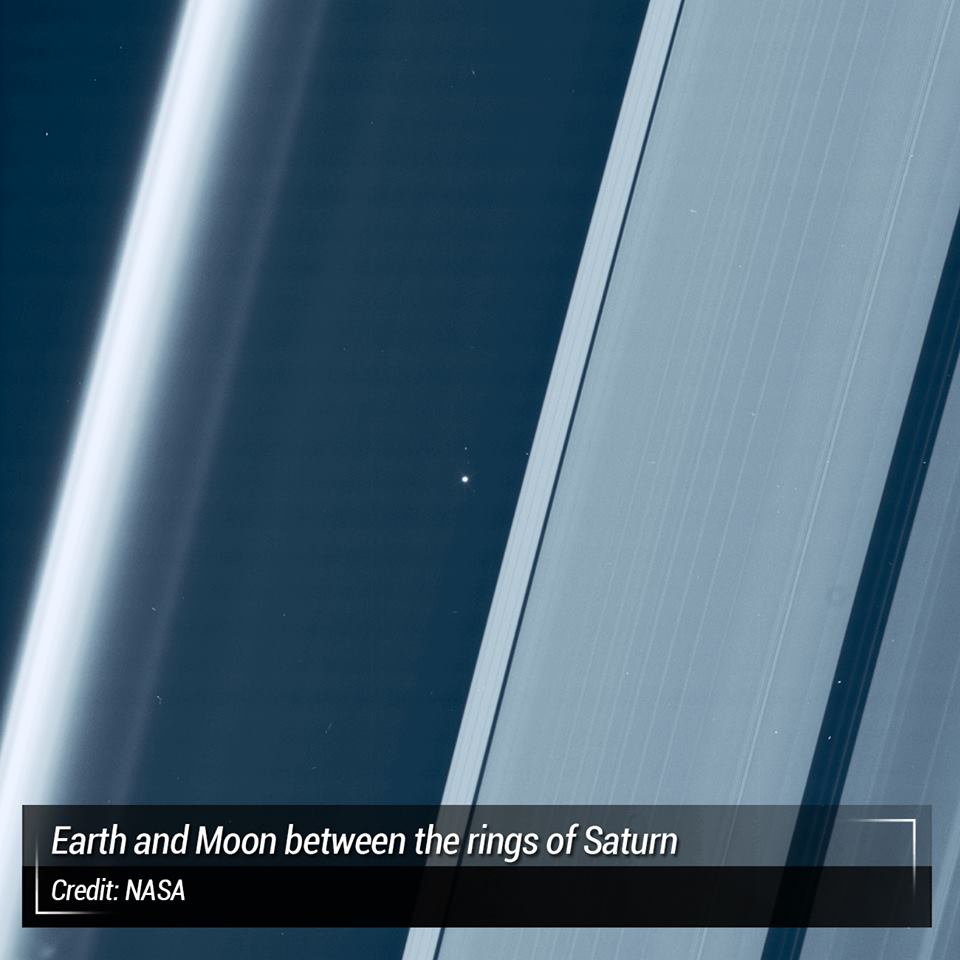
This photo, taken by NASA's Cassini spacecraft, shows Earth and the Moon as points of light between the icy Rings of Saturn. Cassini was 870 million miles (1.4 billion kilometers) away from Earth when the image was taken.  You have to enlarge to see our moon but it's there.


In 1997, the NASA/ESA Cassini-Huygens mission launched from Earth and began its long journey towards the Saturn system. In 2004, the Cassini orbiter arrived around Saturn and would spend the next thirteen years studying the gas giant, its rings, and its system of Moons. On September 15th, 2017, the mission ended when the probe entered Saturn’s upper atmosphere and burned up.

This was known as Cassini’s “Grand Finale“, which began with the probe plunging into the unexplored region that lies between Saturn’s atmosphere and its rings and culminated with live coverage of it entering the atmosphere. In honor of the mission and NASA’s outstanding coverage of its final months, NASA was recently nominated for an Emmy Award by The Academy of Television Arts & Sciences.


And our galaxy, “the Milky Way”, well: same story but equally lovable. Yeah, we’re kind of small and there are about 200 billion out there in our universe.


But fear not, we may visit other galaxies one day.

 Wormholes do exist and we will find a way to travel within them - count on it! 

In the meantime we have some incredible stuff here small as we are.

We have whimsy.

We have fantasy.

This is an actual free diver swimming underwater for a photo shoot

We have royalty.

Irrelevant as it may seem, aren’t they the picture of royalty? I believe they will be part of the resistance, small but significant.

We have comedy all around us.


We have friends and beautiful children.

My dear friend Alfonzo. I cannot begin to tell you all that he means to me.
Ishmael's daughter Rosa. Ishmael makes me Lomboy tea and delivers it to me every 2-3 weeks to combat my cancer.

 Some general just cool stuff

Tony Wu of Tony Wu Underwater Photography slipped into the ocean to swim with sperm whales, yes. But he sure didn't expect THIS: 

And here’s something very rare. A humpback whale whose fluke markings are on the top surface. I’ve ID’d over 280 individual humpbacks and never seen anything like this.

 After a 400-Year Absence, A Rare Ibis Returns to European Skies

The northern bald ibis is critically endangered, with fewer than 1,000 existing in the wild. But a German group is reintroducing these birds in Europe, where they once thrived, and is using ultralight aircraft to lead them on migrations south toward the Mediterranean.
https://e360.yale.edu/features/after-a-400-year-absence-waldrapp-rare-ibis-returns-to-european-skies

In a display that rivals even the most dazzling of firework shows, millions of firefly squid gather off the coast of Japan each spring to perform a sparkling spawning ritual. 

See the spectacle that photographer Solvin Zankl was able to capture during the brief season when the squids’ orbit intersects with our own: http://bit.ly/2KxpLIc

One more animal pic

Cuthulu, is that you? Nope, just a glass octopus with its THREE hearts. Meet more "aliens of the deep" here: bit.ly/2mC3yNi (Photo by Solvin Zankl) #CephalopodWeek


And then there’s us

If you're drawing your genealogical chart, be prepared to buy a lot more paper because the human race is much older than we thought. According to a team led by Jean-Jacques Hublin of the Max Planck Institute for Evolutionary Anthropology and Abdelouahed Ben-Ncer of the National Institute for Archaeology and Heritage in Morocco, fossils and stone tools found in a cave 100 km (62 mi) west of Marrakesh show that Homo Sapiens has been around for at least 300,000 years.


A scientific consortium has found that human ancestors were scattered across Africa, and largely kept apart by a combination of diverse habitats and shifting environmental boundaries, such as forests and deserts. Millennia of separation gave rise to a staggering diversity of human forms, whose mixing ultimately shaped our species. 


Also new findings from “The Iceman”

In 1991, German tourists discovered a human body that was later determined to be the oldest naturally preserved ice mummy, known as Otzi or the Iceman. 

Now, researchers who have conducted the first in-depth analysis of the Iceman's stomach contents offer a rare glimpse of our ancestor's ancient dietary habits. Among other things, their findings show that the Iceman's last meal was heavy on the fat. 

And more discoveries:
Ancient tools and bones discovered in China by archaeologists suggest early humans left Africa and arrived in Asia earlier than previously thought.

The artifacts show that our earliest human ancestors colonized East Asia over two million years ago. They were found by a Chinese team that was led by Professor Zhaoyu Zhu of the Chinese Academy of Sciences, and included Professor Robin Dennell of Exeter University. The tools were discovered at a locality called Shangchen in the southern Chinese Loess Plateau. The oldest are ca. 2.12 million years old, and are c. 270,000 years older than the 1.85 million year old skeletal remains and stone tools from Dmanisi, Georgia, which were previously the earliest evidence of humanity outside Africa.


Last thoughts


Intellectual freedom, science not myth.